
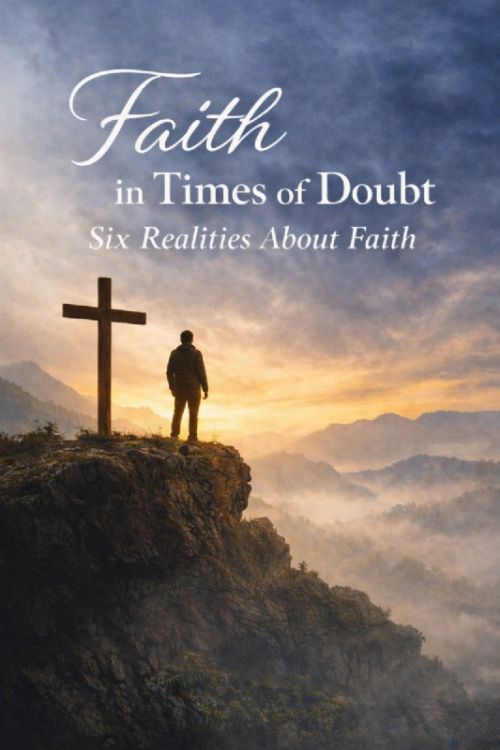
Introductory Matters
Let me begin by saying that this article originated as a sermon that I preached at a local church in my community last year. As is clearly evident, my faith (and likely yours as well) is being continuously tested. So I decided to revisit my notes for this sermon as this new year begins. I was encouraged by what I preached—I was edified by my own notes. It was like listening to your own sermon, being encouraged by what you hear, and learning from it. For this reason, I decided to write this article so that, as the Apostle Paul said to the Roman, “we may be mutually encouraged by each other’s faith, both yours and mine” (Romans 1:12).
With this brief introduction, this article will focus on faith. For our purposes, I will be expositing a few verses from Hebrews 11. But before I do that, let me briefly tell you about this rich epistle in the New Testament, because this is relevant to our discussion.
The book of Hebrews was written to Jewish believers who were considering abandoning their faith in Christ and returning to Judaism. The letter exhorts them to remain steadfast and to persevere to the end. Therefore, if you are struggling in your faith, finding it difficult to grow in faith, or wrestling with doubt, this message is for you.
What Is Faith?
How would you define faith?
One common definition describes faith as strong confidence in and reliance upon someone or something. But the biblical definition, as you will see in a minute, is much deeper than that.
Hebrews 11:1 defines faith as “the assurance of things hoped for, the conviction of things not seen.” Notice that the Bible gives a two-part definition for faith. This is the only time the Bible gives us a clear, straightforward definition of anything, using this formula (“Faith is…”). Two words in this verse deserve special attention: assurance (or literally, substance) and conviction.
The Greek word translated “assurance” conveys the idea of a title deed—a legal document that proves ownership. In other words, it is the legal document one relies upon to prove ownership of property, such as a house or a parcel of land. Thus, the first part of this definition is that faith is what our hope relies upon or rests upon. Put differently, faith is the evidence that what God has promised already belongs to us. In Hebrews 1:3, Jesus is described as the exact imprint of God’s nature, sharing his very substance. In the same way, faith is the substance behind our hope. What does that mean in practice? Simply put, your faith apprehends as real that which has not yet come to pass. It captures the reality of future promises and makes them present. In other words, your treat what is not yet in your hand as if it is.
The second word, “conviction,” refers to compelling evidence or proof—evidence that persuades someone of the truth beyond doubt. Faith is being fully convinced of things we cannot see, trusting what God has promised, even if we cannot see it yet.
Faith, then, rests on God’s promises, acts upon them, and holds steadfast to them even when circumstances seem to contradict them. Faith is when you believe that what God says, God does.
Let us now turn to our text from Hebrews 11.
Hebrews 11:1–12
For the sake of completion and for your convenience, let me share with you these twelve verses in their entirety:
Now faith is the assurance of things hoped for, the conviction of things not seen. For by it the people of old received their commendation. By faith we understand that the universe was created by the word of God, so that what is seen was not made out of things that are visible. By faith Abel offered to God a more acceptable sacrifice than Cain, through which he was commended as righteous, God commending him by accepting his gifts. And through his faith, though he died, he still speaks. By faith Enoch was taken up so that he should not see death, and he was not found, because God had taken him. Now before he was taken he was commended as having pleased God. And without faith it is impossible to please him, for whoever would draw near to God must believe that he exists and that he rewards those who seek him. By faith Noah, being warned by God concerning events as yet unseen, in reverent fear constructed an ark for the saving of his household. By this he condemned the world and became an heir of the righteousness that comes by faith. By faith Abraham obeyed when he was called to go out to a place that he was to receive as an inheritance. And he went out, not knowing where he was going. By faith he went to live in the land of promise, as in a foreign land, living in tents with Isaac and Jacob, heirs with him of the same promise. For he was looking forward to the city that has foundations, whose designer and builder is God. By faith Sarah herself received power to conceive, even when she was past the age, since she considered him faithful who had promised. Therefore from one man, and him as good as dead, were born descendants as many as the stars of heaven and as many as the innumerable grains of sand by the seashore. (Hebrews 11:1–12, ESV)
At the end of chapter 10 (the one before the text we just read), the writer of Hebrews exhorts believers not to throw away their confidence, reminding them that endurance is necessary in order to receive what God has promised (Hebrews 10:35–39). Then he writes the passage above. Faith is presented not as a momentary decision but as a way of life—one that sustains believers through waiting, uncertainty, and testing. Hebrews 11 then unfolds a series of examples that show what faith looks like in action.
Initial Observations About the Text: What Faith Does
Before we dive deeper into our text, let me make the following initial observations from the passage we just read. These observations highlight the effects of faith in one’s life, or, said differently, what your life might look like if you have biblical faith.
1. Faith brings commendation from God. Scripture tells us that by faith, the people of old received God’s approval, or, as the author of Hebrews puts it, “received their commendation” (11:2).
2. Faith believes God’s word. This begins with the creation of the world itself. Look at what v. 3 says: “By faith we understand that the universe was created by the word of God, so that what is seen was not made out of things that are visible.” This means that when you have faith, you believe what God’s word says, beginning with the Bible’s first verse, “In the beginning, God created the heavens and the earth,” (Genesis 1:1) and ending with what the book of Revelation says in its conclusion: “‘Surely I am coming soon.’ Amen. Come, Lord Jesus!” (Revelation 22:20). Those who do not have faith do not believe Scripture, including its testimony that God created all things out of nothing and, consequently, everything the Bible says happened afterward.
3. Faith pleases God. Enoch is presented as one who pleased God through faith, and Scripture plainly states that without faith it is impossible to please him (Hebrews 11:5–6). If you are walking in faith, your life will be pleasing to God.
4. Faith enables us to see what is unseen. Noah acted on God’s warning about events that had not yet occurred. His faith made him righteous in God’s sight (11:7).
A powerful illustration of this truth appears in Numbers 13. Moses sent twelve spies (one from each tribe of the Israelites) to spy out the land that they were about to enter to possess. After forty days of searching out the land, the spies returned. Ten of them gave this dim report: “The land, through which we have gone to spy it out, is a land that devours its inhabitants, and all the people that we saw in it are of great height… and we seemed to ourselves like grasshoppers, and so we seemed to them” (Numbers 13:32–33).
Two of the spies, however, Joshua and Caleb, trusted God and believed he would give them the land. They gave a very different report. Here is what they said. As you read it, keep in mind that they too saw the same land, saw the same people, saw the same fortified cities, and yet, look at how different their report was: “and said to all the congregation of the people of Israel, “The land, which we passed through to spy it out, is an exceedingly good land. If the LORD delights in us, he will bring us into this land and give it to us, a land that flows with milk and honey. Only do not rebel against the LORD. And do not fear the people of the land, for they are bread for us. Their protection is removed from them, and the LORD is with us; do not fear them” (Numbers 14:7–9).
Their faith set them apart. For this single act of unbelief, the LORD made Israel wander in the wilderness for forty years (what should have been an eleven-day journey!).
5. Faith also secures inheritance. Abraham obeyed God’s call and went out without knowing where he was going (Hebrews 11:8–9). Abraham left his hometown, his family, and everything he knew behind to follow God without having so much as a foothold in the land of Canaan. He died, his son Isaac died too, and his grandson Jacob died as well, and the promise still had not been fulfilled. It was not until generations later that Abraham’s descendants, the Israelites, came to possess the land of Canaan. True faith is like holding God’s hand and closing your eyes, letting him lead without knowing or asking where he is taking you.
6. Faith sustains believers during their earthly sojourn. Abraham lived as a foreigner in the land of promise, looking forward to a city built by God himself (Hebrews 11:10). What kept him going and pressing forward was his complete confidence and conviction that the LORD would, one day, fulfill his promise.
7. Faith also enables believers to see future blessings as present realities. Isaac, Jacob, and Joseph all acted in faith concerning promises they would not see fulfilled in their lifetimes. As the writer of Hebrews puts it, “These all died in faith, not having received the things promised, but having seen them and greeted them from afar, and having acknowledged that they were strangers and exiles on the earth” (Hebrews 11:13).
Six Realities About Faith
1. Faith Is Not a Feeling
Faith cannot be defined by feelings, because feelings change with circumstances. Faith is demonstrated through obedience. Abel offered as sacrifice the best of what he had; Noah spent decades building the ark before one drop of rain fell on the earth; and Abraham journeyed for years, and so did his descendants, before the promised land became theirs.
When faith feels weak, the question is not how we feel internally, but whether we are willing to obey God enough to keep pressing ahead. True faith is revealed through action, not words.
2. Faith Comes by Walking With God
Enoch’s life demonstrates that faith grows through daily communion with God. Prayer and Scripture are essential. Time with God must be guarded and prioritized because faith does not grow apart from a relationship with the LORD. Guard your daily time in prayer and Bible-reading as if your life depends on it because, in many ways, it does!
3. Faith Is Continually Tested by Trials
Abel was persecuted. Abraham was tested by God himself: “After these things God tested Abraham and said to him, ‘Abraham!’ And he said, ‘Here I am.’ He said, ‘Take your son, your only son Isaac, whom you love, and go to the land of Moriah, and offer him there as a burnt offering on one of the mountains of which I shall tell you’” (Genesis 22:1–2).
Trials refine faith just as fire refines gold. They are not signs of failure, but of authenticity. When trials come, do not be discouraged but continue walking with God.
4. True Faith Is Continually Growing
Faith is not static. Like a tree, living faith grows. Abraham did not believe God’s promise of a son at first (Genesis 17:17). Sarah, his wife, laughed, even when she heard the promise coming out of the Lord’s mouth personally! (Genesis 18:12) Moses, though he was speaking to the LORD face-to-face (in the burning bush!), did not believe he was good enough to go down to Egypt and free the Israelites: “But Moses said to God, ‘Who am I that I should go to Pharaoh and bring the children of Israel out of Egypt?’” (Exodus 3:11). All struggled at first but grew in trust through obedience.
Ask yourself whether you are growing in intimacy and knowledge of the Lord. (If not, I will give you some recommendations below.) Scripture exhorts us to grow in grace and in the knowledge of Jesus Christ: “You therefore, beloved, knowing this beforehand, take care that you are not carried away with the error of lawless people and lose your own stability. But grow in the grace and knowledge of our Lord and Savior Jesus Christ. To him be the glory both now and to the day of eternity. Amen” (2 Peter 3:17–18).
5. Faith Stands Contrary to Human Reasoning
God’s promises to Abraham defied human logic. The three Hebrew young men trusted God in the face of a fiery furnace. Having defied the decree of Nebuchadnezzar, king of Babylon, refusing to worship his idol, they were headed to certain death in the fiery furnace. But listen to how they answered the king: “O Nebuchadnezzar, we have no need to answer you in this matter. If this be so, our God whom we serve is able to deliver us from the burning fiery furnace, and he will deliver us out of your hand, O king” (Daniel 3:16–17).
Their faith was contrary to the reality they were looking at—the fiery furnace. Faith does not deny reality, but it trusts God beyond what is visible.
6. Faith Is Not a Tool to Manipulate God
If your faith opposes the sovereignty of God, it is not biblical faith. Some people think that their faith entitles them to a certain outcome or action from God. They say, “If I have enough faith, then God must do such as such.” Or they think they can force God’s hand to act in a certain way or within a set timeframe. But this is not how biblical faith works.
True faith is not dependent on outcomes. God cannot be manipulated that way. I just mentioned the three Hebrew young men. They trusted in God even if he chose not to deliver them. Their faith in God was not dependent on whether God would deliver them.
Let me say it this way: If your faith depends on what God does for you, it is not biblical faith. This is because God does not work for you; you work for him (or you should!). This is exactly why many lose their faith and walk away from their faith when God “does not come through” for them the way they expect. The LORD never promised to live up to your expectations, but he commended that you live up to his.
True faith submits to God’s sovereignty rather than demanding results. You pray in faith—whatever your prayer is— and God answers however he desires. If faith depends on what God does for us, it is not biblical faith. God does not serve our expectations; we serve his.
Conclusion: How Do We Get More Faith?
So what should you do if your faith is not where it should be? Let me offer a few suggestions.
First of all, let me say that faith grows only through communion with God. There is no other way. If you do not have a daily sit-down with the LORD in prayer, start doing that. If you do not know how to pray or how to pray regularly, join a prayer group, or partner up with other believers who can encourage you to pray. Here is a practical tip: start by praying for others—your family, friends, church pastors, local community, and so on.
Second, if you do not read your Bible daily, start doing that. Choose a daily Bible-reading plan and commit yourself to it. (There are literally hundreds of these plans online and through apps.) If you do not know how to do that or need encouragement, start a Bible-reading routine with other believers in your local church.
Third, if you already pray and read your Bible daily, dedicate one or two days every week to study a chapter from your weekly reading. Spend some time meditating on the word of God, not just reading it. Use a journal or a notebook to take notes of what the Lord imparts to you from your assigned reading. This will create a wealth of Spirit-filled insights that you can go back to years from now, read them, and be encouraged.
A final word as I close. When faced with trials and tribulations, the faith of many becomes challenged. Oftentimes, they ask, If he is all-good and all-powerful, why doesn’t God just eliminate all pain and suffering and stop all evil? My answer to that is: He will, but that time has not come yet. The time for that will be in the age to come when there will be no more pain, grief, or death.
Then I saw a new heaven and a new earth, for the first heaven and the first earth had passed away, and the sea was no more. And I saw the holy city, new Jerusalem, coming down out of heaven from God, prepared as a bride adorned for her husband. And I heard a loud voice from the throne saying, “Behold, the dwelling place of God is with man. He will dwell with them, and they will be his people, and God himself will be with them as their God. He will wipe away every tear from their eyes, and death shall be no more, neither shall there be mourning, nor crying, nor pain anymore, for the former things have passed away." Revelation 21:1–4
I pray that you have found this article edifying and uplifting to your faith. As the title of this article suggests, to bolster your faith in times of doubt, remember that faith does not eliminate doubt, but it carries believers through it. It does not promise ease, but it anchors your hope. It rests not in circumstances, but in the unchanging character of God. Faith does not heal every illness; it does not move every mountain; it does not remove every obstacle or solve every problem; but it carries you through all these with endurance and patience.
Be always blessed in the mighty name of our Lord Jesus Christ.


