
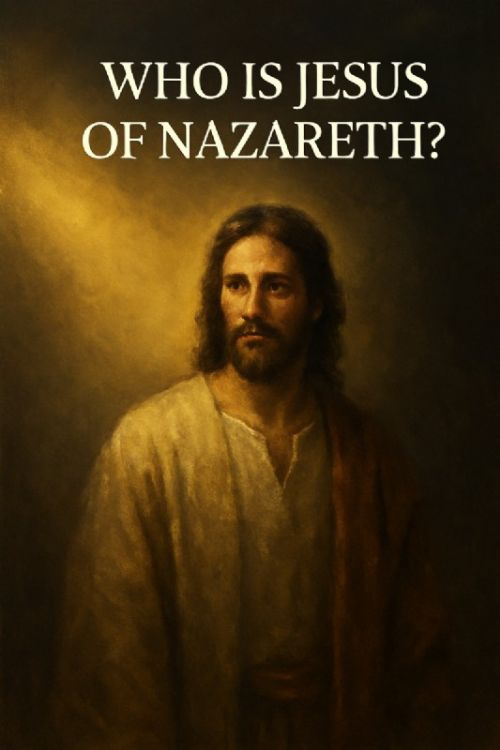
A Unique Question for a Unique Man
This article covers one of the most pivotal questions every human being must answer at some point in his or her life—and it is one on which your life depends! The person of Jesus of Nazareth is different than every other man who walked the face of this earth. The question of his identity is one that every man and woman must contend with during their lifetime here on earth. Jesus is also different in that the answer to this simple question will decide one’s destiny, both now in the present age and in the age to come. No other prophet, teacher, or miracle worker has a more decisive—and divisive—identity than Jesus of Nazareth. In this article, I will share with you my thoughts not on who Jesus is, but on what your answer to this question—one way or another—really means. So I encourage you to read on.
Who do you say that I am?
In Matthew 16:15, we read that Jesus asked his disciples who people said he was. Then he asked them, “Who do you say that I am?” This is the same question our Lord Jesus challenges every human being to answer. No other question is more significant than this simple question: Who is Jesus of Nazareth? Is he a mere man? Is he a mere prophet? Is he just a teacher of “good” morality? Or is he the Son of God and the Son of Man, mentioned in the book of Daniel?
I saw in the night visions, and behold, with the clouds of heaven there came one like a son of man, and he came to the Ancient of Days and was presented before him. And to him was given dominion and glory and a kingdom, that all peoples, nations, and languages should serve him; his dominion is an everlasting dominion, which shall not pass away, and his kingdom one that shall not be destroyed. (Dan. 7:13-14)
Why This Question Determines Your Destiny
Your answer to the question of Jesus’s identity will determine your eternal destiny. In fact, let me bold enough to say this: How you identify the person of Jesus of Nazareth will determine everything else in your life—both here on earth and after you die! No other question is more important to your eternal destiny than this one: Who do you believe Jesus of Nazareth is? But perhaps the answer is more nuanced than you realize and than is typically portrayed. In essence, that nuance is what this article aims to unpack. To do that, let us look at what happened after Jesus asked his disciples who they believed he was.
The Bible tells us that after Jesus confronted his disciples with this question, Simon Peter answered, “You are the Christ, the Son of the living God.” Jesus immediately blessed him saying:
Blessed are you, Simon Bar-Jonah! For flesh and blood has not revealed this to you, but my Father who is in heaven. And I tell you, you are Peter, and on this rock I will build my church, and the gates of hell shall not prevail against it. I will give you the keys of the kingdom of heaven, and whatever you bind on earth shall be bound in heaven, and whatever you loose on earth shall be loosed in heaven. (Matt 16:16-19)
Clearly, this is the answer that aligns with Jesus’s true identity. Based on Peter’s confession, some argue that if one believes that Jesus is the Son of God, one is saved. But before we rush to conclusions, we must pause and consider whether we have truly understood what Scripture says, especially if the issue is so central to one’s eternal destiny. Far too many have settled for quick answers without examining what their answers really mean. If this question determines your eternal destiny, then you must allow Scripture—not tradition or emotions—to speak plainly and fully, and you must not allow others to answer it on your behalf. This is your destiny—not theirs.
The Bible Was Not Written in Verses
Many quote Romans 10:9 to evidence that salvation comes by believing in the heart and confessing with the mouth. Many cling to a verse without considering its context, its conditions, or the full biblical teaching about a specific topic. Most Bible readers, including preachers, tend to treat individual Bible verses as self-contained units of thought, which they are not. Most Christians today, when they read or quote the Bible, usually begin at the start of a verse and stop at the end of that verse or chapter. This severs the verse or chapter from its larger context. Except for a handful of occasions (such as the book of Proverbs), individual verses should not be treated as complete units of thought. When the Bible was written, it was not divided into chapters or verses. Almost every book of the Bible was written as a continuous body of text and was intended to be read as such. These man-made additions came much later (chapter division in the 13th century AD and verse divisions in the 16th century AD). Thus, nearly any Bible verse must never be singly quoted or relied upon as if it means something in and of itself—it must be read in the context of the surrounding verses. (There are, of course, exceptions, but those are usually quite clear from the text itself, such as certain parts of the historical and prophetic books. See, for example, the historical chapters in Isaiah 36-39.) Let us examine what this means in practice.
Misreading Romans 10:9
Take Romans 10:9 as an example. This is the go-to verse for many to prove that to be saved, one needs only believe in his or her heart and confess with their tongue. But is that the whole of what the Bible teaches about receiving salvation? Is that what the author (Paul in this case) had in mind when he sat down to write those words? Let us look at that verse in its context (in this case, we need only examine the immediate context of that verse—meaning, the verses immediately surrounding it!).
In that verse, Paul says, “If you confess with your mouth Jesus as Lord, and believe in your heart that God raised him from the dead, you will be saved” (Rom. 10:9). Properly interpreted in its context, Paul was not giving an exhaustive formula for salvation. He was, in fact, expounding to his audience how readily available salvation is under the new covenant compared to the old. Under the old covenant, righteousness was achieved by doing (i.e., obeying the commandments of the Old Testament). However, under the new covenant, Paul explains, righteousness is attained by faith. In other words, righteousness that comes by and through the law required work (following the numerous commandments and statutes of the law)—a tall order for anyone. So tall in fact that no one was ever able to achieve it—except our Lord Jesus. In contrast, righteousness that comes by and through faith is much more attainable—it only requires believing in the heart and confessing with the mouth. Here is how Paul actually phrased it:
For Moses writes about the righteousness that is based on the law, that the person who does the commandments shall live by them. But the righteousness based on faith says, “Do not say in your heart, ‘Who will ascend into heaven?’” (that is, to bring Christ down) “or ‘Who will descend into the abyss?’” (that is, to bring Christ up from the dead). But what does it say? “The word is near you, in your mouth and in your heart” (that is, the word of faith that we proclaim); because, if you confess with your mouth that Jesus is Lord and believe in your heart that God raised him from the dead, you will be saved. For with the heart one believes and is justified, and with the mouth one confesses and is saved. (Rom. 10:5-10)
Notice here that the last verse (v. 10) emphasizes Paul’s intended meaning. It is with the heart that one believes to justification, and with the mouth that one confesses to salvation. No more effort or “hard work” is required to follow the letter of the law as it once was. In other words, Romans 10:9 emphasizes the accessibility of righteousness and justification by faith, rather than giving a detailed definition of what those concepts mean or how to achieve them. In no way did Paul intend his assertion to be an all-encompassing doctrine on salvation, as it is—sadly—often misunderstood. Therefore, treating Romans 10:9 as the ultimate, all-inclusive formula for salvation would be a serious misinterpretation and a dishonesty toward Paul's original meaning.
Satan and the Art of Flawed Hermeneutics
When Satan tried to tempt our Lord Jesus, he quoted Scripture—but also out of context. He did that in what seemed to be a truthful manner. But, in fact, it was a gross misapplication of Scripture. Ultimately, what Satan did may be described as, simply put, flawed hermeneutics.
Taking Jesus to the elevated wing of the temple and asking him to throw himself off, Satan quoted this verse from the Psalms: “He will command his angels concerning you… on their hands they will bear you up, so that you will not strike your foot against a stone” (Matt. 4:6 quoting Ps. 91:11, 12). Does that verse exist in the Psalms? Yes, it does. Did Satan quote it verbatim? Yes, he did. He was very accurate.
In essence, Satan was asking our Lord to put God to the test using Scripture. But Jesus did not fall into the trap of relying on a single verse of Scripture, taken out of its context, misinterpreted, and misapplied—nor should you. Imagine what would have happened if our Lord had not been well-versed in the Scriptures!
Why One Passage Is Never Enough
When examining what the Bible teaches about a certain topic, it is of utmost importance to take into account all the verses that relate to that topic and not just a couple—and certainly not only one.
In Matthew 25:31-46, our Lord states that in his return to judge the earth, he will judge everyone based on these six criteria: (1) feeding the hungry; (2) giving drink to the thirsty; (3) sheltering the stranger; (4) clothing the naked; (5) visiting the sick; and (6) visiting the imprisoned. Those who performed these acts of love and mercy—whom our Lord calls, "the sheep"—will be welcomed into his kingdom. Those who did not—"the goats"—will be cast out into the outer darkness and eternal punishment.
If we were to take this parable alone—as some do with Romans 10:9—as the basis of our theology on salvation, it would be sufficient for believers and non-believers alike to inherit the kingdom of God if they were to perform these acts of mercy. This would essentially annul nearly every other teaching on salvation and justification found in the Bible. In fact, it would render the very sacrifice of Christ itself unnecessary. I do not believe that any Bible-believing Christian would take that position.
The same can be said about James's definition of pure and undefiled religion in the sight of God the Father: "Pure and undefiled religion in the sight of our God and Father is this: to visit orphans and widows in their distress, and to keep oneself unstained by the world" (James 1:27). I doubt that many Christians would adopt the notion that to be saved, they only need to help the orphans and support the widows and remain isolated from the world and its cares. These examples and others illustrate the danger of basing a doctrine on a single verse of the Bible concerning a specific topic, while overlooking other, related teachings on the same subject.
This leads us to a crucial issue: Do belief in the heart and confession by the mouth guarantee salvation? You might think that faith is enough to be saved, based on Romans 10:9, as discussed above. Since Scripture—properly understood and contextually interpreted—never contradicts itself, we must let Scripture interpret Scripture. When we do, we see that our Lord warns us against a shallow confession—a confession that lacks the substance of a transformed life.
Is Confession Alone Enough?
I am compelled to say that not everyone who calls himself a follower of Jesus is, in fact, so. But let us look at what Scripture itself declares.
Our Lord issues a terrifyingly sobering warning concerning merely professing him as Lord and savior. In the last day, many will say to him, “Lord, Lord, did we not prophesy in your name, and in your name cast out demons, and in your name perform many miracles?” to which he will answer, “I never knew you; depart from me, you who practice lawlessness” (Matt 7:22-23).
They did not prophesy in someone else’s name; they did not cast out demons in some else’s name; and they did not perform miracles in someone else’s name. They did all that in his name! They knew him by name—but he did not know them. This warning should sober every one of us. It reveals that outward activity—even miraculous signs—does not prove a person belongs to Christ (what Paul beautifully often refers to as, “In Christ Jesus”). But there is more.
Fake believers are not the only ones who believe in the one God or even confess Jesus as the Son of God. Concerning the belief in one God, James tells us that if you believe in God, “You do well; the demons also believe, and shudder” (James 2:19). So belief in God alone does not distinguish a person from demons. John, on the other hand, writes, “Whoever confesses that Jesus is the Son of God, God abides in him, and he in God” (1 John 4:15). Based on this verse—and Romans 10:9—you might think that belief and confession are sufficient for salvation and for experiencing God's presence.
These two verses may appear contradictory, but they are not. Read and properly interpreted in their respective contexts, these two verses tell us that while confession is required (John), it is not wholly sufficient (James). John was comparing those who believe that Jesus is the Son of God to those who do not. James was comparing those who claim to believe but whose conduct does not demonstrate their faith to those whose conduct aligns with their professed belief. But the issue goes even deeper.
In addition to James’s declaration, Scripture testifies that demons themselves confess Jesus as the Son of God. If you do not believe me, believe the Scriptures:
- “What business do we have with each other, Son of God? Have you come here to torment us before the time?” (Matt. 8:29)
- “What business do we have with each other, Jesus of Nazareth? Have you come to destroy us? I know who you are—the Holy One of God!” (Mark 1:24)
- “Whenever the unclean spirits saw him, they would fall down before him and shout, ‘You are the Son of God!’” (Mark 3:11)
Thus, demons believe in one God—and shudder—and they also confess that Jesus is his Son! Scripture does not merely warn us about false disciples. It sets before us a startling comparison that few have ever seriously considered. If mere belief or even verbal confession were enough, then what would distinguish us from the very spirits who recognized and confessed Jesus—and yet opposed him at every step?
The Demons Believe—And Know
The testimonies above of these unclean spirits are not incidental. The gospel writers preserved these events for a reason. They show that correct theology by itself is not the mark of a redeemed heart. The demons recognized Jesus accurately, addressed him truthfully as the Son of God, and submitted to his authority—yet they remained demons, destined to eternal damnation!
But we all understand that the devil is a liar and the father of lies (John 8:44). Therefore, although the demons acknowledged Jesus as the Son of God, they might have been lying and perhaps they truly did not know his true identity. If that is your position, let me share with you what Luke writes by the Holy Spirit:
- “Demons also were coming out of many, shouting, ‘You are the Son of God!’ But rebuking them, he would not allow them to speak, because they knew him to be the Christ” (Luke 4:41)
Notice then that in this case, they were not lying; they truly knew who Jesus was. Notice also that this was not a forced confession that they were obligated to give, for Jesus himself did not want them to profess him as the Son of God. Nor could we contend that, although they confessed with their mouths that Jesus is the Son of God, they, in fact, did not believe that he was raised from the dead, as Paul says in Romans 10:9. Demons do not need to believe—the way we do—that God raised Jesus from the dead—they know he did. They were there 2,000 years ago when it all happened—none of us was! They saw it as eyewitnesses—we did not.
At this point, the question becomes unavoidable: if demons possess accurate beliefs about God, about Christ, and about his resurrection, then something deeper must separate the children of God from the enemies of God. Scripture forces us to confront this distinction honestly, not to trouble us, but to lead us into the very heart of true discipleship.
So What Sets a True Believer Apart?
If the demons believe that God exists and is one, and if they know that Jesus of Nazareth is his Son, and if they saw him crucified and then raised from the dead, then what is the difference between a believer and a demon in that regard? The key is obedience.
The one thing that sets a believer apart from all others (demons and those of Matthew 7:22-23, who will be rebuked in the last day) is obedience and submission to the commands of our Lord Jesus. One thing a demon (and a fake believer) will never do is obey the Son of God. This is why our Lord gave us this crucial test:
- “If you love me, you will keep my commandments” (John 14:15)
- “Whoever has my commandments and keeps them, he it is who loves me. And he who loves me will be loved by my Father, and I will love him and manifest myself to him” (John 14:21)
- “If anyone loves me, he will keep my word, and my Father will love him, and we will come to him and make our home with him” (John 14:23)
- “If you keep my commandments, you will abide in my love, just as I have kept my Father’s commandments and abide in his love” (John 15:10)
Once Scripture exposes this truth—that obedience is the dividing line—it naturally directs our eyes to the one who exemplified perfect obedience—Jesus. Our Lord never commands us to walk where he himself has not walked. The path he calls us to follow is the very path he trod from the manger to the cross. In the words of the author of Hebrews: "For because he himself has suffered when tempted, he is able to help those who are being tempted" (Hebrews 2:18).
Follow Christ as He Obeyed
Relevant to this discussion is another question that one must consider concerning what our Lord said and how he lived during his earthly ministry. Did Jesus only say that he was the Son of the Father, or did he also obey the Father? Did he only honor his Father with words or also in deed? The truth is that he obeyed the Father all the way to death on the cross!
When we see Christ’s obedience—not theoretical, not partial, but full and costly—it becomes clear that true faith cannot remain passive. The grace that saves us is the same grace that transforms us, produces obedience in us, and conforms us to the image of Christ. Anything less falls short of the faith Scripture describes. Simply put, and in the words of the Holy Spirit written by James, "So also faith by itself, if it does not have works, is dead" (James 2:17). These are the works (fruit) of obedience, not the works of the law.
Thus, do not just believe in your heart and confess with your mouth that Jesus is Lord and is the Son of God—you must obey him also! After all, this is the only thing that will set you apart from everyone who will be in the lake of fire and brimstone!
Last, I will leave you with this question to ponder: Where is Christ calling you to obey—not in theory, not in emotion, but in practice?
If this teaching encouraged you, share it with someone who needs clarity about who Jesus truly is—and what it truly means to confess him as Lord.
Click here to join my mailing list and receive my latest articles and resources directly in your inbox. You can also connect with me on Facebook or LinkedIn.


